B2B SEO 101: Strategies, Costs, and Best Practices

Ashot Nanayan
SEO Strategist
Table of content
Every year, more and more B2B companies invest in SEO, especially after the rise of AI search engines. But SEO is not all the same, and in many cases, old-school tactics no longer make sense and end up being a real waste of time.
Over the last few years, we’ve run dozens of B2B SEO campaigns for companies across a wide range of sectors, including B2B SaaS, IT, manufacturing, enterprise, and local businesses. As a result, I have a lot to share with you.
In this guide, I’m excited to walk you through my B2B SEO playbook: proven strategies, experiments, common questions I hear from clients, cost expectations, and everything else you need to get your B2B SEO right from day one. So, let’s get into it.
Ready to grow smarter?
Book a free 30-minute strategy call with our team. We'll audit your search visibility and build a custom action plan.
What is B2B SEO?
B2B SEO is the process of helping your business appear in Google, Bing, AI search engines, and other platforms when other businesses are looking for the products or services you offer.
In other words, instead of trying to attract everyday consumers, you are targeting business owners, managers, procurement teams, or other key decision-makers.
In many cases, search volume is lower, but the value of each lead is much higher. That is why B2B SEO usually focuses on high-intent service pages, useful content, strong trust signals, and topics that match how buyers search, whether they are using Google or AI-powered search engines (E.g., ChatGPT) to compare options and find solutions.
B2B SEO vs. B2C SEO
I don’t want to confuse you; B2B and B2C SEO follow the same foundation. In both cases, you still need a well-optimized website, strong content, good user experience, and enough authority to compete in search results.
However, the way SEO works in practice can look very different. The audience, search intent, buying journey, and even the type of pages that drive results often change a lot from B2B to B2C, so here’s a simple side-by-side comparison.
Goal
Drive traffic, product sales, bookings, subscriptions
Generate qualified leads
Metrics
Organic traffic, transactions, conversion rate
SQLs, MQLs, demo requests
Content
Shorter, simpler, product-led, benefit-focused
Built for buyers who compare and research
Buyer Journey
Usually more direct
Messy and non-linear
Decision-Makers
Usually one buyer or household decision-maker
Multiple people are involved
Keyword Volume
High Volume
Lower volume but often higher value
The Importance of SEO for B2B
SEO is one of the most important growth channels for B2B businesses because this is how buyers behave now. They do their own research, quietly compare options, read service pages, review case studies, and only reach out when they feel they’ve found a serious option.
Statistics
That means people are often looking for a solution first, not for your company name, so if you are not visible there, you can lose good opportunities before the sales conversation even starts.
10 Practical B2B SEO Strategies That Work for Us
I’ve been working on B2B SEO projects since 2019, and over the years, I’ve seen a wide range of clients, from B2B eCommerce brands to enterprise manufacturing companies, and from content strategy to B2B link-building and everything in between.
Like anyone who has been in SEO long enough, I’ve had wins, failures, frustrating setbacks, and plenty of lessons, especially after major core updates. In some cases, I managed to recover. In others, I had to rethink the whole approach.
That’s why I wanted this section to be practical. Below, I’m sharing 8 B2B SEO strategies that have worked for me. They come from our client work, experiments, real challenges, and many years of hands-on experience in the SEO industry.
1. Go After Zero-Volume Keywords
One of the biggest mistakes I still see in B2B SEO is relying too much on SEO tools like Ahrefs or Semrush to decide whether a keyword is worth targeting. But, please don’t think like an old school SEO, because especially in B2B, things work very differently.
Many of the best opportunities do not show strong search volume at all, and some of them appear as zero-volume keywords. But that does not mean they have no value.
I’ll give you a simple example from my own experience.
We targeted the keyword “oil and gas SEO agency,” which showed almost no competition and little to no meaningful volume in Ahrefs.
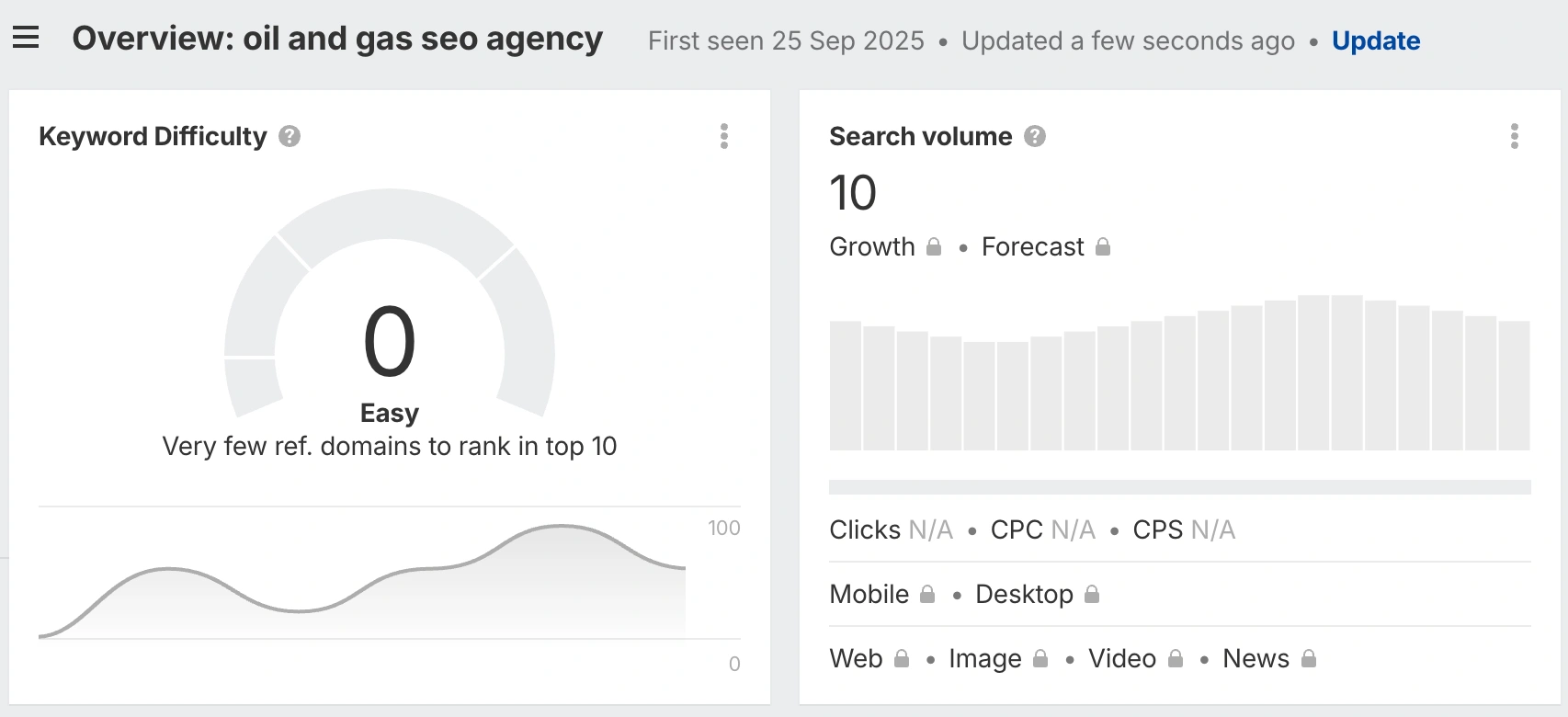
However, the keyword brought us a client worth $10,000 per month.
That’s why I keep saying B2B SEO is not the same anymore. You cannot judge a keyword only by what a third-party tool shows you.
This is even more true now, when many long-tail searches happen as detailed prompts in ChatGPT, other LLMs, and Google.
A lot of valuable search behavior does not appear properly in the tools people use every day.
If you want to find such low-handing opportunities, one of the first places I recommend looking is Google Search Console.
In my opinion, it is one of the most underrated sources for B2B keyword research.
You have to review the data carefully, because in many cases, Search Console shows valuable queries that SEO tools completely miss.
2. Get Featured in the Industry Listicles
One strategy I’ve paid much more attention to over the last couple of years is getting clients featured in industry listicles. I do not mean random low-quality roundup posts.
I mean relevant articles like in our case, “best B2B SEO agencies,” “top ERP software for manufacturers,” or “best cybersecurity companies for healthcare providers.”
Believe me, it’s much more important than many businesses realize, especially in B2B, where even a few highly relevant clicks from the right article can turn into leads, sales calls, and long-term clients.
The second reason I take this seriously is AI search. I keep seeing ChatGPT, AI Overviews, and similar platforms recommend top products and services from recommendation-style pages, comparison pages, and strong editorial roundups when they surface providers, tools, or companies.
Google’s own documentation says its AI search features use web content and links to help people explore topics, and OpenAI has also described ChatGPT’s search and shopping experiences as relying on public web sources and review-style information.
So, as a B2B SEO agency, we consider this strategy for almost every serious client. In many cases, appearing in the right listicles doesn’t just help with referral traffic. It can also improve visibility where people increasingly discover brands today.
3. Run PR Link-Building Campaigns
Our team runs dozens of B2B link-building campaigns at the same time, and one thing I keep seeing again and again is that most B2B companies are still far behind when it comes to off-page SEO.
When analyzing competitors, we usually find one of two things. Either they are barely doing any real SEO at all, or they are building weak links through PBNs, link farms, random directories, low-quality guest posts, niche edits, or basic link exchanges (For B2B SaaS, especially).
That’s why I believe PR link-building can move a company several steps ahead of its competitors.
If you really want to separate yourself, you should not ignore digital PR or HARO-style link building. It should be part of your overall B2B SEO strategy.
I have no doubt about that. In most industries, a huge percentage of competitors still do not invest in this properly, which creates a real opportunity for companies that do.
4. Get More Reviews on the Directories
Another strategy I strongly recommend for B2B SEO is getting your business listed in the right B2B directories. For example, if you are doing SEO for IT & tech companies, platforms like Clutch, DesignRush, G2, and other relevant directories are very valuable.
The same idea applies to every sector. If you are working on B2B healthcare SEO, manufacturing SEO, or any other niche, you should take the time to find the directories that matter in that industry.
Last week, I got a message from Clutch that says, in the past 30 days alone, Clutch was cited nearly 7.5 million times in LLM responses.
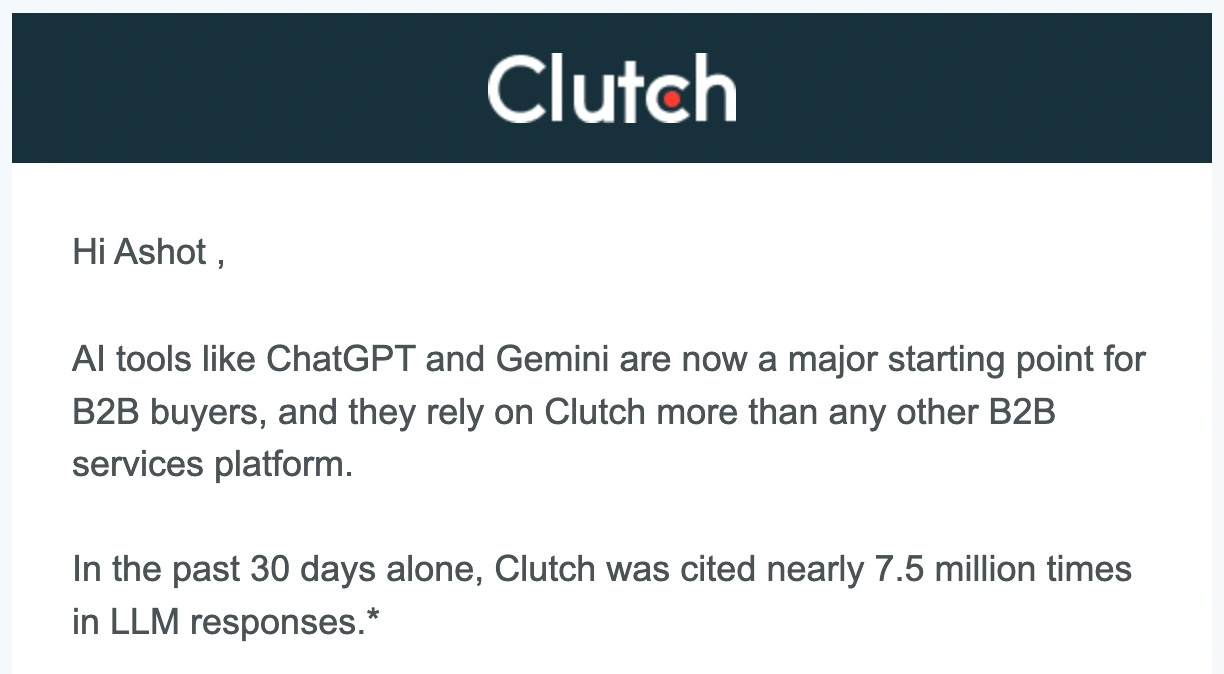
Do you imagine what that means? (Incredible, really.)
But of course, just creating profiles is not enough. You should also collect honest client reviews on each platform.
I especially paid attention and found out that on average, ChatGPT picks Clutch profiles with at least 12-15 reviews.
I do not know how much this may change tomorrow, but today it is working incredibly well.
So if you want to position your company as a strong choice in traditional search and AI-driven search, remember what I recommended, my friend.
5. Optimize for LLMs (AI SEO)
I always say that AI SEO is mostly just strong SEO done properly. If your website has helpful content, clear structure, strong topical coverage, authority, and strong brand signals, you are already doing most of what matters for both Google and AI search engines like ChatGPT, Perplexity, and others.
However, there are still a few details that seem to matter more for LLMs than for traditional search.
I would say 95% of the work overlaps, but the remaining 5% comes down to certain patterns that AI tools appear to reward more heavily.
So below, I want to walk you through the main tips and tactics I’d recommend if you want to improve your chances of appearing not only in traditional search results, but also in LLM-driven answers.
-
1
Appear in Listicle Articles
B2B buyers often ask AI tools for “best,” “top,” and “recommended” vendors. Getting mentioned in relevant listicles, review pages, and comparison articles increases the chances of your brand being pulled into AI-generated shortlists.
-
2
Target BOFU Topics
Create pages for comparison, alternatives, pricing, use cases, industries, and high-intent service queries. LLMs often need clear, specific sources when users ask who to hire, which tool to choose, or what solution fits their business.
-
3
Build Brand Reputation
Earn mentions from PR publications, niche websites, podcasts, directories, review platforms, and industry blogs. AI search doesn't only look at what you say about yourself; it also looks for signals that other trusted sources recognize your brand.
-
4
Make Your Content Easy to Quote
Write clear definitions, direct answers, comparison tables, pros and cons, FAQs, stats, and expert commentary. AI systems are more likely to cite or summarize content that is structured, specific, and easy to extract.
6. Publish Industry-Relevant Case Studies
Publishing industry-relevant case studies is one of the smartest things you can do in B2B SEO. Search engines want to see real experience, proof, and outcomes, and case studies help with all three.
But beyond SEO, they also help a lot with trust. In B2B, potential clients rarely make decisions based on promises alone. They want to see what you’ve done, who you’ve helped, what changed, and whether you can solve a problem like theirs.
The more specific and relevant the details are, the better.
Make sure your case studies are indexable, internally linked from relevant service pages and blog posts, and written around the actual problems your target audience cares about.
Use a clear structure: the client or business type, the challenge, what you did, and the results.
If you cannot name the client publicly, you can still make the case study useful by being specific about the niche, the problem, and the outcome.
In my experience, case studies often do more than just support rankings. They help turn SEO traffic into real leads, which is why I believe they are one of the highest-B2B SEO ROI content assets.
7. Don’t Forget about LinkedIn
LinkedIn can become a lead generation machine for B2B SEO, believe me. I’ve received many leads from LinkedIn alone through my personal profile. It usually happens when your profile is positioned clearly, your expertise is visible, and people can immediately understand what you do and who you help.
But if I had to point to one tactic that works especially well, it would be publishing LinkedIn articles.
For example, I got six SEO students from this listicle I published last year.

Yeah, surprisingly, I still have time to take SEO courses.
As you see, I’m talking about niche-specific articles, listicle-style pieces, comparison content, and practical posts around the exact topics your audience cares about, even if the search volume looks small.
This works a lot like parasite SEO.
In simple words, you are publishing on a strong platform that Google already trusts, so your LinkedIn article can rank much faster than a brand-new article on your own website.
8. Strengthen Your E.E.A.T.
Google rolls out new algorithm updates several times a year, but a huge part of these updates comes back to one thing: making sure websites publish high-quality, relevant content that reflects real expertise.
Strong signals of experience, expertise, authority, and trust are often what separate average websites from the ones that continue to perform well over time.
That’s even more important if you work in a sensitive niche that falls under Google’s YMYL standards. In those cases, Google tends to look much more carefully at who is behind the content, whether the information is trusted, and whether the website shows clear signs of credibility.
Below are some of the main things I would pay attention to when optimizing a B2B website for stronger trust and authority.
-
1
Show the Real Experts Behind the Content
Add clear author bios, reviewer details, credentials, LinkedIn profiles, and industry experience. For B2B, it's very important because buyers want to know whether the advice comes from someone who has worked with similar companies, budgets, sales cycles, and growth problems.
-
2
Publish Proof, Not Just Opinions
Use case studies, client examples, before-and-after results, screenshots, original research, and real project learnings.
-
3
Earn Mentions from Trusted Sources
Get featured in niche publications, podcasts, expert roundups, directories, partner pages, and reputable media outlets.
-
4
Update Content With Firsthand Experience
Refresh important pages with new examples, lessons, expert notes, screenshots, quotes, and recent observations from real client work.
9. Develop a Strong Content Strategy
Out of every 10 clients who come to us, a large portion either have almost no content at all or publish random blog posts with no clear direction behind them.
In B2B (And in general), that is a serious issue. You cannot expect strong SEO results when your content is not tied to your services, your buyers, or the way people search before making a business decision.
Of course, the right approach depends on the type of business you run. I mean, B2B SEO for an eCommerce company will not look the same as B2B SEO for a local service business, a SaaS company, or an enterprise provider. In some cases, it makes more sense to invest more in authority building first.
In others, content development, landing pages, or commercial pages should be the priority. However, most businesses are creating content without any strategy behind it, and that is a major red flag.
So, I strongly recommend building a B2B SEO content strategy based on your industry, your competition, your services, your target audience, your sales cycle, and the search intent behind the topics you want to target.
If you want to go deeper into this, I’ve also prepared a dedicated guide on how to build an SEO content strategy for B2B businesses.
10. Leverage International SEO (If Applicable)
I would not reinvent the wheel here. In most industries, the toughest SEO competition is usually in English-speaking markets. So, yeah, my friend, other languages can open up real opportunities.
I’ve mentioned this before in my B2B SaaS SEO guide, but it is worth repeating here as well. If your business can realistically serve other countries and languages, this is a very strong growth opportunity.
In B2B SaaS, for example, it is often possible to target markets such as Spain, Brazil, Portugal, and others where search demand exists but the SEO competition is much weaker.
What I like about this approach is that you do not have to guess blindly.
You can test a new market first with Google Ads, see whether the leads are relevant and whether conversion potential is there, and then decide if it is worth investing in SEO for that language or country.
If the results look promising, you can start building out localized pages and content for those markets. This works especially well for enterprise B2B SEO that already serves multiple regions, languages, or countries.
As I said, when applicable, international B2B SEO can become a very strong advantage, not just an extra tactic.
What’s the Best B2B SEO Strategy for Small Businesses?
It’s hard to say “ This is the #1 strategy for small B2Bs ” because SEO is a combination of multiple strategies. A lot depends on what kind of company you run, how competitive your niche is, and who you are trying to reach.
Doing SEO for a local B2B service business is very different from doing SEO for a SaaS company in New York or a provider competing in a crowded national market.
First, I would learn the basics of SEO as much as possible, especially if the budget is tight, because SEO is not cheap, and even basic knowledge can save you from wasting money.
Then I would do a quick B2B SEO audit and make sure the fundamentals are in place. After that, I would focus on building around 10 to 15 strong bottom-of-the-funnel pages or articles, with good internal linking between them and proper on-page optimization across the site.
Once the foundation is in place, I would put most of my effort into increasing the authority of the website.
IMO, many small B2B websites do not fail because they wrote too little content. They fail because they never built enough authority around the content that is very important.
Your First 90 Days of B2B SEO: What to Expect
There is a reason SEO experts keep saying, “It depends.” It may sound repetitive, but it is true (lol). Your first 90 days of B2B SEO can look very different depending on where the business is starting from.
Taking over a site that already has some authority, content, and technical foundation is one thing. Starting with a brand-new website is something else entirely.
If we are talking about a new website, the first 90 days are usually less about instant results and more about building the right foundation.
Here is what our agency’s process looks like:
Implementation roadmap for B2B companies
Foundation Audit
Full review of your rankings, technical health, content gaps, competitors, conversion paths, and highest-value B2B opportunities.
Strategy Buildout
Turn the audit into a clear 90-day roadmap covering target pages, keyword clusters, content priorities, technical fixes, and revenue-focused actions.
Priority Page Optimization
Rewrite and improve service, solution, industry, comparison, and demo-focused pages to match buyer intent and support lead generation.
Content & Topic Expansion
Build useful BOFU and MOFU content around pain points, alternatives, use cases, integrations, pricing, and decision-stage searches.
Authority Building
Improve internal linking, strengthen topical depth, earn relevant backlinks, and build third-party trust signals around your key categories.
Scale & Refine
Monitor rankings, qualified leads, assisted conversions, and sales feedback, then adjust the strategy based on what creates real pipeline.
Timeline Expectations
In most B2B cases, the first 3 months are about groundwork. During this stage, you may see early movement in impressions, keyword rankings, and maybe a few small wins, but usually not a huge lead flow yet.
By month 6, if the strategy is solid and the budget is enough to execute, you should normally start seeing some positive results: better rankings, stronger organic traffic, and the first consistent leads from SEO.
By month 12, SEO should start feeling like a real growth channel, especially if you are in a niche where one good lead is worth a lot.
Google also says that some SEO changes can show results in days, but many improvements can take several months to be properly recognized, especially at the site level.
From my experience, low-competition B2B niches with a decent website and healthy budget can show meaningful progress faster. On the other hand, if you are in a competitive space like SaaS, cybersecurity, legal, finance, or enterprise services, it can take longer because you are competing against stronger domains with more content and more backlinks.
Statistics
A useful benchmark here is Ahrefs’ 2025 study: only 1.74% of newly published pages ranked in Google’s top 10 within a year, and 72.9% of top-10 pages were more than three years old.
That does not mean new websites cannot win, but it does mean SEO usually takes patience, especially in competitive markets.
Expert Insights from Industry Experts
1. You should not focus only on bottom-funnel keywords. In B2B, buyers usually take longer to decide, so SEO should also cover educational and mid-funnel topics, not just service or demo pages, explains Neil Patel, co-founder of NP Digital and the marketer behind Ubersuggest
2. Andy Crestodina – co-founder and CMO of Orbit Media Studios explains that one of his strongest ideas for B2B SEO is that content is not just there to “bring traffic.” Its real job is often to help your commercial and service pages rank by attracting links, building authority, and supporting the rest of the site.
3. Ryan Law – Director of Content Marketing at Ahrefs – His insight is very useful for B2B companies: do not chase traffic for its own sake. He often emphasizes choosing topics with real business potential, meaning the content should be connected to what the company sells, not just what gets clicks.
4. Brian Dean, founder of Exploding Topics and Backlinko, says that a key takeaway from Brian Dean’s work is that not all backlinks are equal. For B2B SEO, the best links usually come from relevant, trustworthy websites that make sense in context, not just from pages with attractive SEO metrics.
5. Rand Fishkin – co-founder of SparkToro and former co-founder of Moz shares – my broader marketing insight is especially relevant to B2B SEO: a lot of search demand is created outside Google first.
People may hear about your brand through communities, podcasts, social posts, newsletters, or word of mouth, and only later search for you. That means B2B SEO often works best when brand demand and visibility grow together.
6. Wil Reynolds – founder of Seer InteractiveHis explains that the big point is that ranking alone is not enough. In B2B, content should also build trust, get shared privately, and influence buying decisions.
That is especially true in niches where decision-makers pass content around in Slack groups, emails, and internal chats before anyone fills out a form.
B2B SEO Costs (Calculator Included)
On average, B2B SEO can cost anywhere from $1,500 to $10,000+ per month, depending on your goals, competition, website size, content needs, and whether link-building is included.
For smaller or less competitive B2B campaigns, the budget may stay closer to the lower end, while serious SaaS, enterprise, or national campaigns usually land much higher.
If you look at pricing models, hourly SEO in the U.S. often falls around $75 to $200+ per hour, and experienced agencies or specialists can charge more.
Project-based SEO, such as audits, strategy work, or one-time setup, usually starts around $1,000 to $5,000+, but larger or more technical projects can go well beyond that.
SEO ROI Calculator
Estimate your potential return from an SEO investment.
Projected Results
Projected Traffic
Monthly Leads
Additional Revenue
Estimated ROI
+5733%
based on 2.4× traffic multiplier
Projections based on industry averages. Actual results vary by niche, competition, and execution quality.
Top B2B SEO KPIs: What I Personally Prioritize
It’s no secret that a lot of SEO agencies still send blurry, B2B SEO reports full of numbers that look impressive but do not help the client understand what is going on.
In B2B SEO, especially, you need to focus on the KPIs that show progress, business value, and whether your SEO effort is moving in the right direction.
So here are the B2B SEO KPIs I personally believe matter most from day one. These are the numbers I would pay close attention to if the goal is not just more traffic, but better leads, better visibility, and clearer SEO decision-making.
The Metrics That Separate Real B2B SEO From Busy Work
SEO KPIs help you see what matters most: better-fit leads, stronger sales opportunities, higher-intent traffic, and measurable pipeline influence.
| KPI | What It Shows | Why It Matters in B2B SEO |
|---|---|---|
| Qualified Organic Leads | How many leads come from organic search and match your ideal customer profile. | Traffic means little if it does not turn into real conversations with the right companies. |
| Demo or Consultation Requests | How many visitors book a call, request a demo, or submit a serious inquiry. | This connects SEO directly to sales opportunities, not just rankings. |
| Pipeline Influenced by SEO | The estimated deal value connected to organic search visits, assisted conversions, or first-touch leads. | B2B SEO should support revenue, especially when buyers take weeks or months to decide. |
| Organic Traffic to Money Pages | Traffic going to service, solution, product, industry, pricing, and comparison pages. | These pages are usually closer to revenue than general blog traffic. |
| Keyword Rankings by Intent | Rankings split by BOFU, MOFU, and TOFU keywords. | A B2B site can rank for many keywords and still miss the searches that buyers use. |
| Content-Assisted Conversions | Blog posts, guides, and resources that help users return later and convert. | B2B buyers rarely convert after one visit, so assisted value matters. |
| Backlink Quality & Relevance | The strength, relevance, traffic, and authority of websites linking to you. | Relevant authority helps competitive B2B pages rank and builds trust around the brand. |
| AI Search Visibility | Whether your brand appears in ChatGPT, Perplexity, Google AI, and other answer engines for key category prompts. | B2B buyers are increasingly using AI tools to compare vendors and shortlist options. |
Common B2B SEO Mistakes
Since I already covered the 10 most important B2B SEO strategies above, I do not want to repeat the same ideas here and simply repackage them as “mistakes.”
A much better way to look at it is this: review your current SEO strategy and compare it with what I recommended in this guide. If there is a big gap between what you are doing now and what should be done, there is a good chance you are already making some costly mistakes.
Honestly, the biggest mistake of all is ignoring SEO entirely. Many B2B companies spend on outbound, paid ads, and sales efforts while giving almost no attention to organic search, even though the value of a strong SEO lead is incredibly high.
The Future of B2B SEO
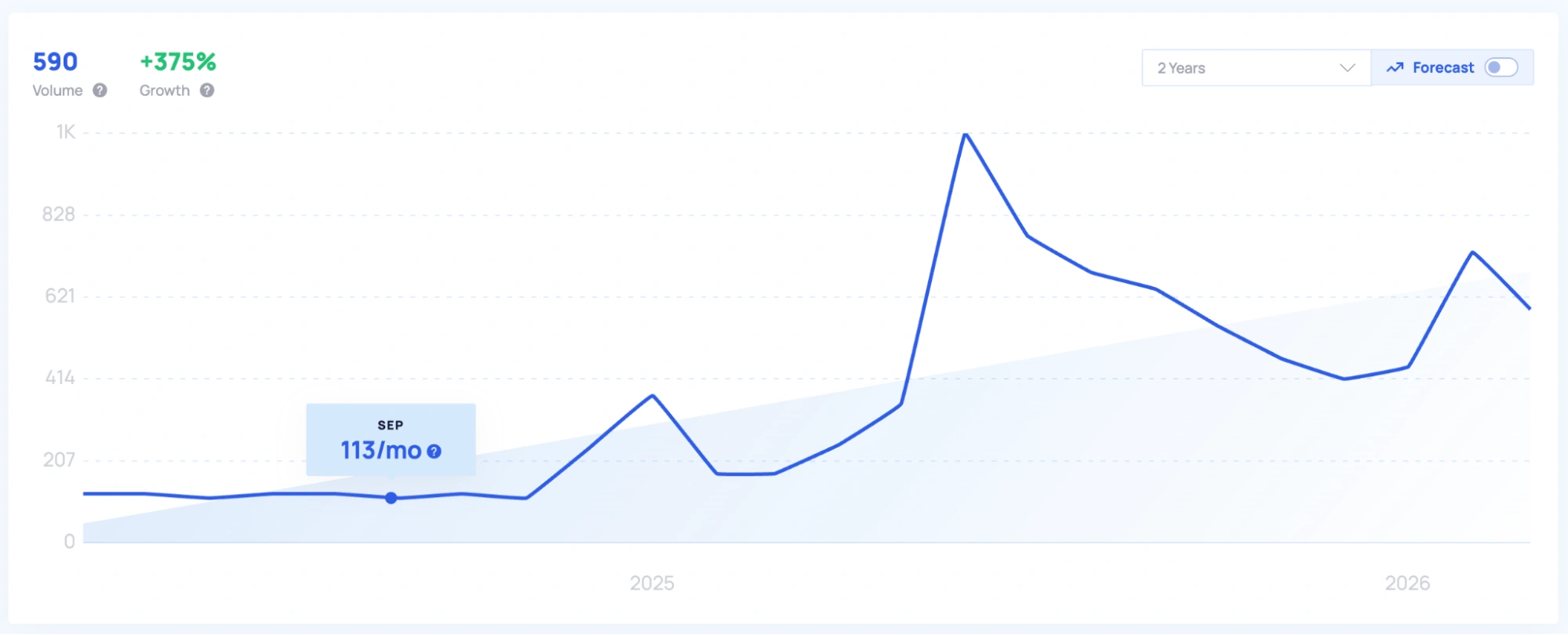
From what I’m seeing, the future of B2B SEO is going to look much bigger than most companies realize. Even the interest around “B2B SEO” itself has been climbing fast, which tells me more companies are finally starting to take it seriously.
Look at this. In the last 2 years, the search volume of the keyword “B2B SEO” has grown by 375%, according to Exploding Topics.
But I honestly think this is still early, and we should not just follow the current B2B SEO trends. The bigger shift is not just that more B2B brands want SEO. It is that buyers are no longer using only Google the way they used to.
They are asking ChatGPT, Gemini, Perplexity, and Google’s own AI experiences for recommendations, comparisons, and answers before they ever fill out a form or book a call.
OpenAI said ChatGPT had reached 900 million weekly active users by February 2026, and Google said its Gemini app had passed 650 million monthly users while AI Overviews were reaching 2 billion users each month.
So when I look at where B2B SEO is heading, I do not just see “rank on Google” anymore. I see a much bigger visibility game where the brands that win will be the ones that build real authority, publish genuinely useful content, appear in the right listicles and mentions, and become easy for both search engines and AI tools to trust.
In other words, the future of B2B SEO will not belong to the companies doing the bare minimum. It will belong to the ones that notice the shift early and build for where buyer attention is going.
The Bottom Line
In my B2B SEO 101 guide, I’ve tried to share the tips, techniques, best practices, and strategies I personally use at our specialized B2B SEO agency, B2BSEO.io. I also covered common mistakes, realistic costs, and the things that matter if you want to build a B2B SEO strategy that leads somewhere.
SEO keeps changing, and in B2B, the stakes are often much higher because one qualified lead can be worth a lot. So, if you’re looking for an agency to turn your traffic into high-quality leads, don’t hesitate to contact us!
What B2B Heywords Should You Target First?
I would usually start with BOFU keywords first, especially the ones with clear commercial intent. These are the keywords that often attract people who are already looking for a provider, a service, or a solution.
After that, I would focus on informational content too, but still with a strong BOFU angle. Then, to strengthen the whole strategy, I would add MOFU and TOFU content to support those money pages and help build more topical authority around them.
How Do You Tie SEO Leads to the Pipeline in a CRM?
The best practice is to make sure every lead coming from organic search is tracked properly from the first touch. In most cases, that means using proper CRM source tagging, form tracking, and clear attribution rules so you can see which pages, keywords, or content types are generating leads.
Is Link-Building Still Necessary for B2B SEO?
Yes, absolutely. There is really no serious second opinion here. I know some SEO agencies offer very small SEO packages where link-building is not even included, but to me, that is a red flag.
Link-building should be a part of your B2B SEO strategy because strong backlinks still help you build authority, compete for valuable keywords, and improve your chances of ranking not only in Google but also across AI-driven search experiences.
Written by
Ashot NanayanSEO Strategist
Ashot Nanayan is an SEO strategist and the founder of B2BSEO.io. He helps B2B companies build search systems that do more than rank pages. His approach connects Google visibility, AI search presence, content depth, authority, and buyer intent, so brands appear where serious decisions start.